
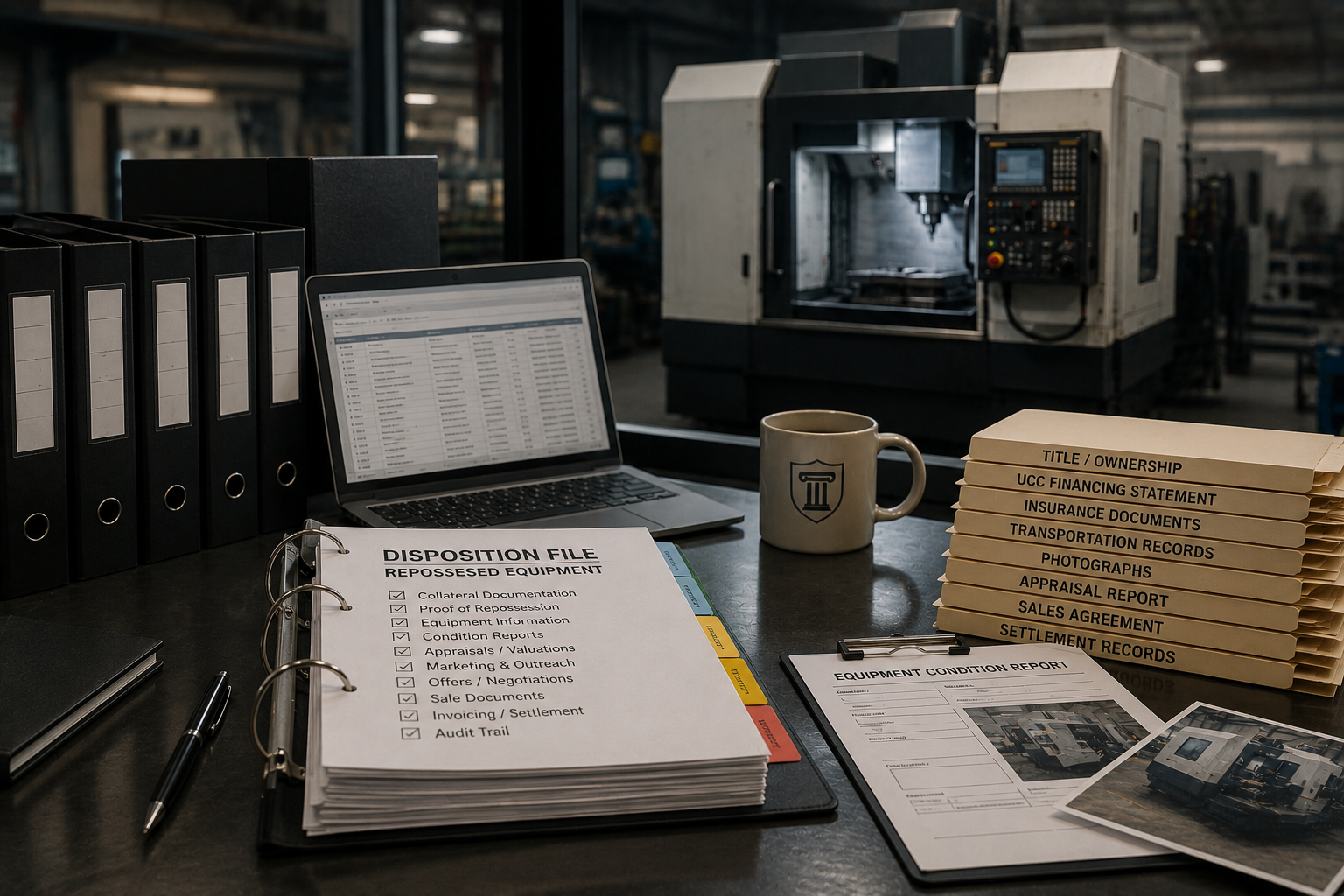
A commercially reasonable sale is only as defensible as the paper trail behind it. If a deficiency claim is ever disputed, or a file comes up in an internal audit or regulatory exam, the documentation is what answers the question of whether the disposition actually met the standard, not memory, not intent, the file.
This is general information, not legal or compliance advice specific to your institution. What follows is the set of records that consistently shows up across well documented equipment dispositions, organized the way most files actually get built.
Why the File Matters as Much as the Sale Itself
As covered in our guide on what commercially reasonable actually requires, the standard applies to the whole process, not just the final number. The file is how that process gets proven after the fact. An incomplete file doesn't just create audit friction, it weakens the institution's position if a deficiency claim is ever challenged.
For SBA guaranteed loans specifically, this matters even more. Lenders operating under SBA SOP 50 57 are expected to pursue prudent, commercially reasonable liquidation and to assemble documentation to support a guaranty purchase request. A thin file can slow down or jeopardize that recovery.
Want a disposition partner who builds the file as part of the process?
Documentation that supports your file from day one, not assembled after the fact.
Talk to a Remarketing Partner →What a Complete Disposition File Should Include
1. Proof of repossession and collateral documentation
The original security agreement, UCC financing statement, and records showing how and when the collateral was retaken. This establishes that the institution had a valid, perfected security interest and that repossession followed the terms of the agreement.
2. Equipment information and condition reports
Make, model, serial number, and a documented condition report, ideally with photographs, taken close to the time of repossession. This becomes the baseline everything else gets measured against.
3. Appraisal or valuation documentation
A market valuation specific to the equipment, not a generic estimate. This is the number the eventual sale price gets compared against, so it needs to reflect the actual brand, model, control vintage, and condition.
4. Marketing and outreach records
Evidence of how the equipment was marketed and to whom. For specialized equipment like CNC machines, this should show outreach to buyers who actually deal in that category, not just a general listing. This is frequently the weakest part of a file when a disposition gets challenged.
5. Offers, negotiations, and the sale agreement
Records of offers received, how the final buyer and price were determined, and the executed sale agreement itself.
6. Settlement, proceeds distribution, and the audit trail
Final settlement records showing how proceeds were applied, costs first, then the secured obligation, along with a clear audit trail tying every step together from repossession through final distribution.
What Happens When a File Is Incomplete
An incomplete file doesn't necessarily mean a sale was not commercially reasonable, but it makes that much harder to prove. Gaps that come up most often:
- No documented valuation before the sale, making it hard to show the final price was reasonable relative to market value.
- No record of marketing efforts, leaving no evidence that the equipment was actually exposed to the right buyers.
- Condition reports missing or undated, making it unclear what state the equipment was in when it was valued versus when it sold.
- No clear reconciliation of proceeds, which can create problems even when the underlying sale itself was handled well.
Working with a partner who builds this documentation as a normal part of the disposition process, rather than reconstructing it after the fact, tends to produce a stronger file with less internal effort.
Building the File as You Go
At repossession
Capture condition, photographs, and collateral documentation immediately, while the equipment's state is undisputed.
Before marketing begins
Get a documented valuation on file before outreach starts, so it can't later look like the number was worked backward from the sale price.
During marketing and negotiation
Log outreach, offers received, and how the eventual buyer was selected as it happens, not reconstructed from memory later.
At settlement
Finalize the proceeds distribution record and close out the audit trail while every step is still fresh and easy to verify.
FAQ
Does every disposition need a full file like this, even for lower value equipment?
The core documents, collateral records, condition, valuation, and settlement, are worth keeping regardless of value. The depth of marketing documentation can scale with the size and complexity of the disposition.
Who typically assembles this file, the institution or the disposition partner?
It varies, but a partner who specializes in the equipment category can usually supply the valuation, marketing, and sale documentation directly, which reduces the burden on internal staff.
What's the most commonly missing piece in files that get challenged?
Marketing and outreach records. Institutions often have solid collateral and settlement documentation but little proof of how the equipment was actually exposed to the market.
How does this connect to an SBA guaranty purchase request?
SBA lenders are expected to document a prudent, commercially reasonable liquidation to support the guaranty purchase file. A weak disposition file can slow that process down.
Get equipment moved with the documentation already built in
A disposition process that produces the file your institution needs, not just a sale.
Talk to a Remarketing Partner →