
An interstate shop move forces a question most owners never sit down and answer directly, which machines are actually worth the cost and hassle of moving, and which ones you'd be better off selling and replacing near the new location. It's tempting to just move everything, but that's rarely the cheapest or smartest path.
Whether you're relocating for lower operating costs, to be closer to a new customer base, or because the work is shifting toward a state with more manufacturing activity, the equipment decision deserves its own plan, separate from the moving truck logistics.
Why This Gets Complicated Fast
Moving a CNC machine isn't like moving office furniture. Riggers have to disconnect, crate, and re-level precision equipment, and re-calibration after the move is its own line item. Shop owners who've done long interstate moves report total equipment moving costs that can run into the tens of thousands of dollars once rigging, transport, insurance, and downtime are added up, and that's before accounting for the machines that end up needing service after the trip.
At the same time, manufacturing activity itself is shifting. Tariff pressure and reshoring incentives are pulling production toward specific states, and shops relocating into those areas often find the work mix on the other end looks different from what they were running before. That changes which machines are actually worth carrying across state lines versus selling to fund equipment that fits the new customer base better.
Not sure what your equipment is worth before you decide?
Get a free, no obligation valuation so you know the real numbers before you commit to a moving budget.
Get My Free Equipment Valuation →The Sell vs. Move Decision, Machine by Machine
Run every machine on your floor through this side by side, not the shop as a whole. The right answer is almost never all or nothing.
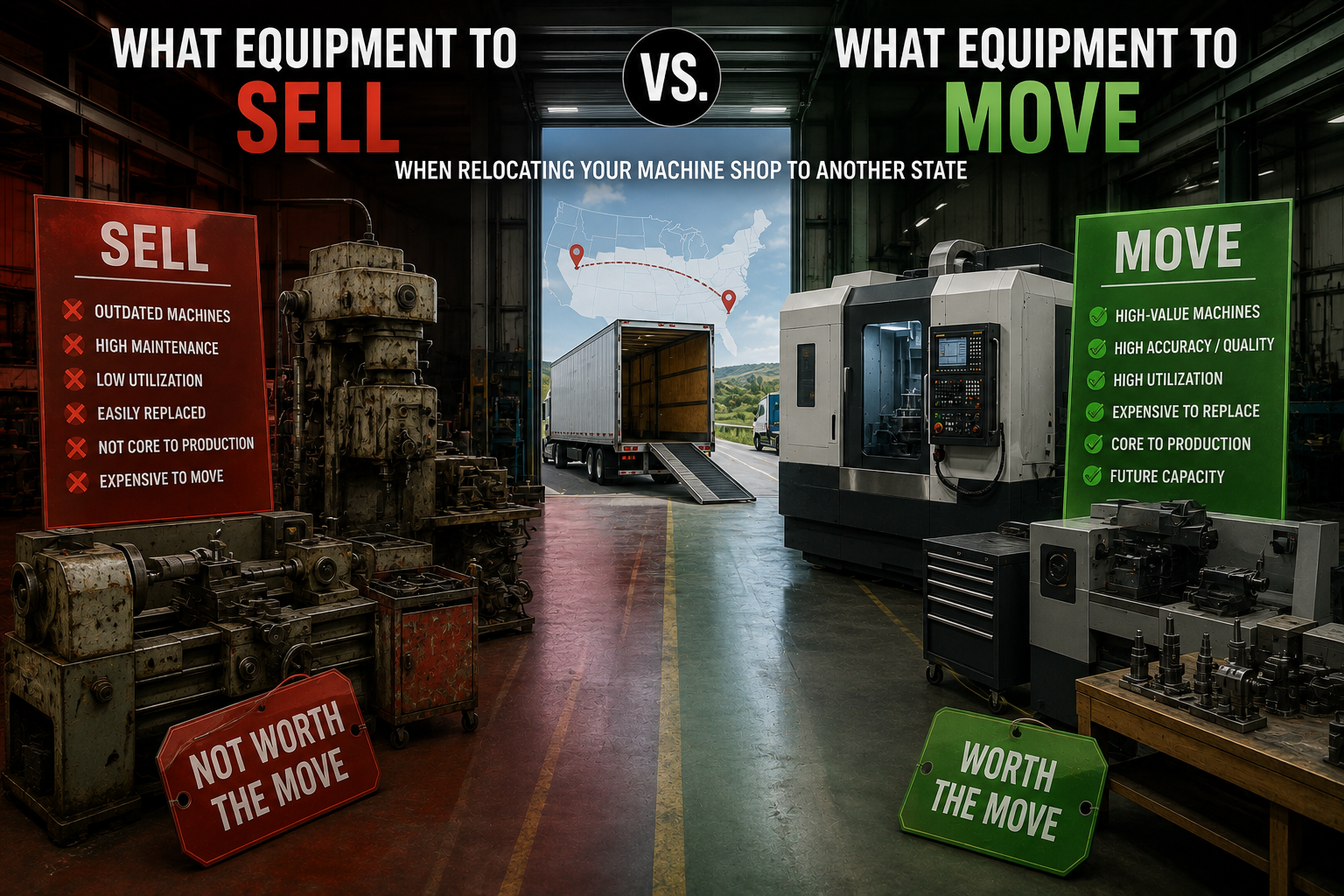
Signs a machine is worth moving
- High value relative to rigging cost. If the machine is worth several times what it costs to move, moving it almost always wins.
- High accuracy or tight tolerance capability. Machines that took years to dial in, or that hold tolerances your new location's used market can't easily replace, are usually worth the trip.
- High utilization. A machine that's been running near capacity is proven demand, not a guess about future work.
- Expensive or slow to replace. Long lead times on new equipment can make moving the machine you already own the faster path to being productive at the new location.
- Core to your production, not incidental to it. If the shop can't run without it, it moves.
Signs a machine is worth selling instead
- Outdated control or mechanical platform. If it's due for a refresh anyway, a move is a natural point to upgrade rather than pay to relocate an aging machine.
- High maintenance history. A machine with a pattern of breakdowns is a bigger risk to move and requalify than to sell as is.
- Low utilization. If it hasn't been earning its floor space where you are now, a new location won't change that.
- Easily replaced locally. Common, widely available machine types are often cheaper to sell here and buy used near the new shop than to rig and haul across state lines.
- Doesn't match the work mix at the destination. If the move is also a shift in customer base or industry focus, equipment built for the old work mix may not earn its keep in the new one.
Want a second opinion on specific machines?
We can give you a straight read on what's worth moving and what's worth selling before you lock in a moving budget.
Get My Free Equipment Valuation →Weighing the Real Cost of Moving It
1. Hire a full service rigger on both ends
The most expensive option, but also the lowest risk to the machine itself. Riggers disconnect, crate, transport, and re-install, and many offer insurance for the trip. This tends to make sense for high value or hard to replace equipment.
2. Hire a rigger to load, then haul it yourself
A middle ground some shop owners use to cut cost on mid distance moves, having a rigger handle the disconnect and loading while you or your team handle the actual transport on a rented trailer.
3. Sell it locally and buy comparable equipment near the new shop
Often the cheapest and lowest hassle option for machines that are common, easily replaced, or not worth the rigging cost relative to their value. It also means you're not waiting on transit time to have working equipment at the new location.
4. Consign or list it before the move, and give yourself a real runway
Specialized machines with a narrower buyer pool take longer to sell well. If you already know a machine isn't making the trip, starting that process early, well before moving day, usually nets a better price than a rushed sale right before you leave.
What's Your Equipment Actually Worth Right Now?
Whether a machine is worth moving often comes down to comparing its resale value against its rigging and transport cost. That means you need a real number for each one before you can make the call. Valuation on used CNC equipment moves on a handful of concrete factors:
- Brand and model. Haas, Mazak, Okuma, and DMG Mori hold value very differently than lesser known import brands.
- Control vintage. A machine on a current generation control is worth meaningfully more than the same mechanical machine on a control that's two or three generations behind.
- Condition and hours of usage. Spindle hours, way wear, and maintenance history all move the number.
- Tooling and accessories included. Tombstones, vises, tool holders, and probing packages can add real dollars to a sale.
Getting this number before you build your moving budget is what turns the sell or move decision from a guess into actual math.
What an Interstate Equipment Move Usually Looks Like
8 to 12 weeks out: Machine by machine sell or move audit
Score every piece of equipment against the framework above before requesting rigging quotes, so you're only paying to quote what's actually staying.
6 to 8 weeks out: Get rigging quotes and list what's not moving
Specialized equipment with a narrower buyer pool should go up for sale now, not the week before the move.
2 to 4 weeks out: Confirm the new location is ready
Power, air, and floor loading at the destination should be confirmed before equipment arrives, not discovered after.
Move week: Disconnect, transport, and re-install
Build in buffer time for re-leveling and re-calibration before you count on the machine for production again.
FAQ
Is it ever cheaper to move a machine than to sell it and buy another?
Often, yes, especially for high value or specialized equipment with a narrow buyer pool or a long lead time to replace. The rigging cost usually only wins out over moving when the machine is common and easily replaced near the new location.
How far in advance should I start deciding what to sell?
As early as possible. Specialized machines can take time to sell well, and rushing a sale right before a move almost always leaves money on the table.
Does moving to a state with more manufacturing activity change what I should keep?
It can. If the work mix at the new location differs from your current customer base, equipment built around the old work may not be the best fit going forward, which is worth weighing alongside the moving cost itself.
Should I get a valuation before or after getting rigging quotes?
Before. Comparing a machine's resale value against its rigging cost is exactly what tells you which option actually makes financial sense.
Get real numbers before you build your moving budget
A free valuation on each machine tells you what's worth moving and what's worth selling first.
Start My Free Valuation →