
When evaluating a modern 5-axis machining center, spindle speed, rotary axis design, and control often get the spotlight. But one of the most important — and least understood — design decisions is the machine structure itself, specifically whether it is built from Meehanite cast iron or mineral cast (polymer concrete).
These two approaches are not the same, and each brings distinct advantages and trade-offs that directly affect accuracy, surface finish, thermal stability, and long-term durability in 5-axis machining.
This article breaks down Meehanite vs mineral cast clearly, without marketing spin.
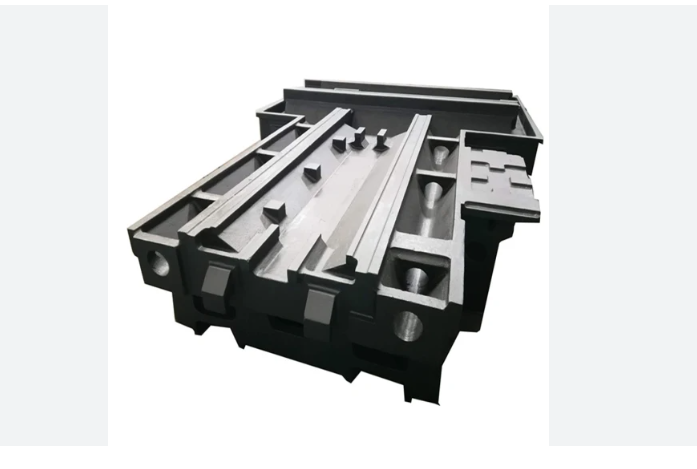 Meehantie Casting
What Is Meehanite Casting?
Meehanite® is not a material — it is a licensed casting process used to produce high-quality gray or ductile cast iron with tightly controlled metallurgy.
Key characteristics:
Metallic cast iron
Controlled graphite structure
High compressive and tensile strength
Consistent mechanical properties
Proven performance in machine tools for decades
Meehanite castings are produced only by licensed foundries following strict metallurgical standards.
Common uses in 5-axis machines:
Bases
Columns
Trunnion supports
Heavy-duty rotary structures
What Is Mineral Cast (Polymer Concrete)?
Mineral cast, also known as polymer concrete or epoxy granite, is a composite material, not metal.
It consists of:
Natural aggregates (granite, quartz, basalt)
Epoxy or polymer binders
Steel inserts for guideways, bearings, and interfaces
Mineral cast components are poured at room temperature, eliminating internal stresses common in metal castings.
Common uses in 5-axis machines:
Machine bases
Columns
Gantry beams
Precision structures for high-speed machining
Head-to-Head Comparison
Property | Meehanite Cast Iron | Mineral Cast |
Material type | Metallic iron | Composite |
Vibration damping | Good | Excellent (5–10× higher) |
Structural stiffness | Very high | High (compression-focused) |
Thermal conductivity | High | Low |
Thermal stability | Moderate | Very high |
Machinability | Excellent | Limited (inserts only) |
Long-term repair | Easier | More difficult |
Proven lifespan | Extremely long | Long but design-dependent |
Why This Matters More in 5-Axis Machining
5-axis machining introduces:
Continuous rotary motion
Changing cutting force vectors
Long simultaneous toolpaths
Higher sensitivity to vibration and thermal drift
Because of this, machine damping and thermal behavior matter more in 5-axis than in 3-axis machining.
Meehanite in 5-Axis Machines: Strength & Durability
Advantages
Excellent rigidity for heavy cutting
Handles shock loads well
Ideal for:
Titanium
Inconel
Stainless steel
Easier to scrape, rebuild, and realign over time
Limitations
Lower damping than mineral cast
Transfers heat more readily
Requires aging or stress relief
Best suited for:
Aerospace roughing
High-torque spindle applications
Large trunnion-style 5-axis machines
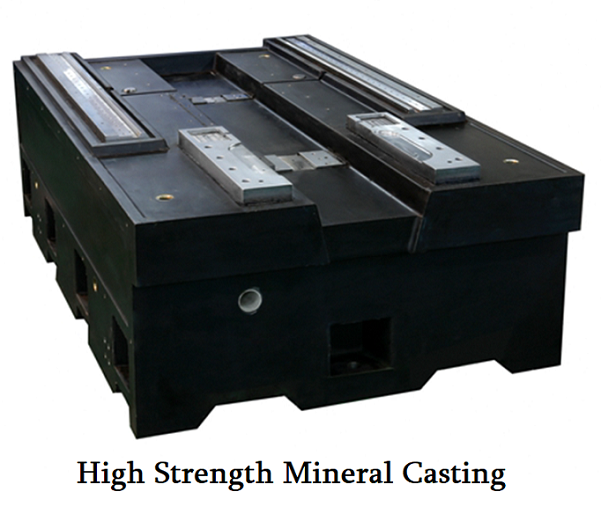 Mineral Casting
Mineral Cast in 5-Axis Machines: Damping & Stability
Advantages
Exceptional vibration damping
Outstanding thermal stability
Excellent surface finish potential
Very low internal stress
Limitations
Lower tensile strength than iron
Depends heavily on steel inserts
Less tolerant of heavy shock loads
Repairs are more complex
Best suited for:
Mold & die
Medical components
High-speed finishing
Precision surfacing
Hybrid Designs: The Best of Both Worlds
Many premium machine builders now use hybrid structures, combining:
Meehanite cast iron for load-bearing elements
Mineral cast for damping-critical components
This approach provides:
Structural stiffness where cutting forces enter the machine
Superior vibration control where surface finish matters most
In practice, hybrid designs often outperform pure cast-iron or pure mineral-cast machines when executed well.
So… Which Casting Is Better for 5-Axis?
The honest answer:
There is no universal “best” casting.
Application Priority | Better Choice |
Heavy roughing | Meehanite |
Hard materials | Meehanite |
High-speed finishing | Mineral cast |
Thermal stability | Mineral cast |
Long-term rebuildability | Meehanite |
Overall balance | Hybrid design |
Final Takeaway-Meehanite vs mineral cast
Meehanite casting excels in strength, durability, and heavy-duty machining
Mineral cast excels in damping, thermal stability, and surface finish
The best 5-axis machines often combine both intelligently
Casting choice should always be evaluated in context of:
Materials
Cutting strategy
Duty cycle
Accuracy expectations
Not brochure claims.