Not every institution organizes this function the same way, and the terminology varies. Some call it Special Assets. Others have a distinct Asset Recovery team. Some smaller institutions don't have either as a formal department and the work falls to whoever's handling the loan. Here's what each function actually does, and how they typically work together when a CNC machine comes back as collateral.
Two Different Jobs, Not Competing Titles for the Same One
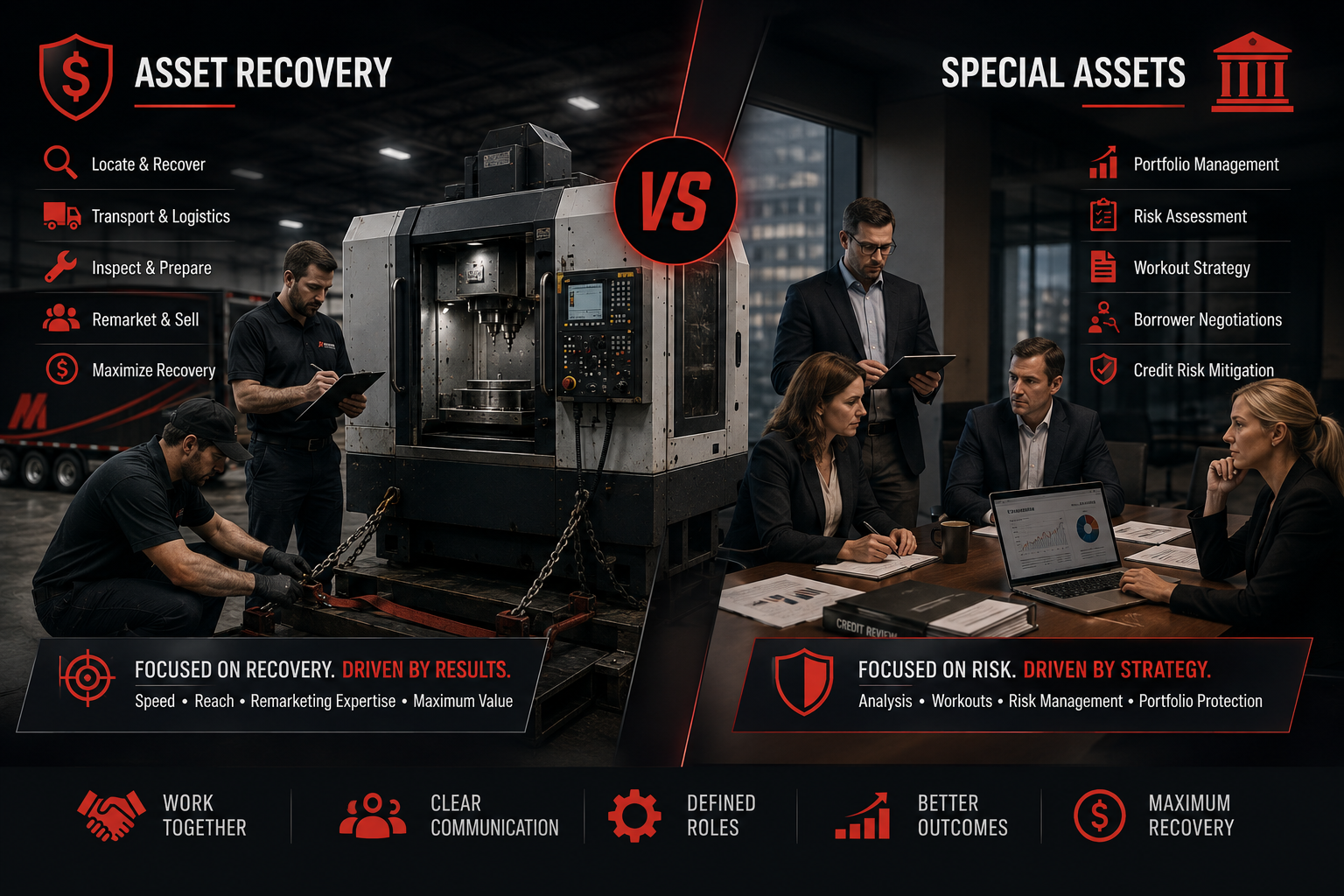
Special Assets is generally focused on risk and strategy, portfolio management, risk assessment, workout strategy, and borrower negotiations. It's the function deciding how to handle a troubled credit overall, of which equipment disposition is one piece.
Asset Recovery is generally focused on execution, physically locating and recovering the collateral, inspecting and preparing it, transporting it, and remarketing it for sale. It's the function that actually gets a repossessed machine off the premises and turned into recovered dollars.
At many institutions, these are two connected functions working together, not two departments competing for the same task. Special Assets sets the strategy and manages the credit relationship, Asset Recovery, sometimes in-house, often through an outside partner, executes the physical disposition.
Not sure which function handles this at your institution?
Either way, we can walk through what a machine tool disposition actually looks like.
Talk to a Remarketing Partner →What Each Function Actually Handles
Asset Recovery: focused on recovery, driven by results
- Locate and recover. Finding and physically retaking the collateral.
- Transport and logistics. Getting the equipment moved and stored properly.
- Inspect and prepare. Condition assessment and readying the equipment for sale.
- Remarket and sell. Marketing to buyers and executing the sale.
- Maximize recovery. The whole function is measured on the dollars recovered.
Special Assets: focused on risk, driven by strategy
- Portfolio management. Overseeing the broader book of troubled or watch-list credits.
- Risk assessment. Evaluating exposure and likely outcomes on a given credit.
- Workout strategy. Deciding the overall path forward on a troubled loan.
- Borrower negotiations. Managing the relationship and negotiation with the borrower directly.
- Credit risk mitigation. Protecting the institution's broader credit risk position.
Why the Handoff Between These Two Matters
- Clear communication, so the disposition timeline aligns with the broader workout strategy.
- Defined roles, so no step falls through the gap between deciding strategy and executing recovery.
- Better outcomes, when both functions are working from the same information and timeline.
- Maximum recovery, the shared goal both functions are ultimately working toward.
How the Handoff Typically Works
Special Assets identifies the credit and sets strategy
The decision to repossess and the broader workout approach gets set here.
Asset Recovery executes the physical repossession
Locating, retaking, and securing the equipment.
Disposition proceeds, often through a specialized partner
Valuation, marketing, and sale, whether handled internally or through an outside remarketing company.
Results feed back to Special Assets
Recovery outcomes inform the final resolution of the credit.
FAQ
My institution doesn't have a formal Special Assets or Asset Recovery department. Who handles this?
At smaller institutions, this often falls to a commercial lender, workout officer, or credit administration generally. The functions described here still apply, just without a dedicated department name attached.
Is Asset Recovery the same as a remarketing partner?
Not exactly. Asset Recovery is the internal function responsible for the process; a remarketing partner is often the specialized outside resource that function relies on to actually execute a disposition for equipment collateral.
Does Special Assets get involved in the actual equipment sale?
Generally not directly, that's typically Asset Recovery's execution work, but Special Assets stays informed since the outcome affects the broader workout strategy for the credit.
Which function should reach out to a remarketing partner?
Either can, depending on how the institution is structured. What matters is that whoever's handling the physical disposition connects with a partner who understands this specific equipment category.
Whoever handles this at your institution, we can help
A straightforward conversation about your specific machine tool collateral situation.
Talk to a Remarketing Partner →