Running the disposition in-house feels like the more direct path, no vendor relationship to manage, no fee to pay, full control over the process. For some institutions with real internal expertise and volume, that's genuinely the right call. For most, once buyer reach, time investment, and net proceeds are actually compared, a specialized remarketing partner tends to come out ahead. Here's an honest look at both sides.
Why This Comparison Isn't as Simple as Fee vs. No Fee
The obvious argument for in-house is avoiding a remarketing fee. But that comparison only looks at cost, not net proceeds. A sale to a narrower buyer pool at a lower price can easily net less than a sale to a wider, more competitive buyer pool minus a fee. The real question isn't whether a fee is paid, it's what number lands on the institution's books after everything is accounted for.
Want a straight comparison for your specific situation?
Get a real read on what a specialized buyer network could mean for a specific machine or portfolio.
Talk to a Remarketing Partner →Where the Two Approaches Actually Differ
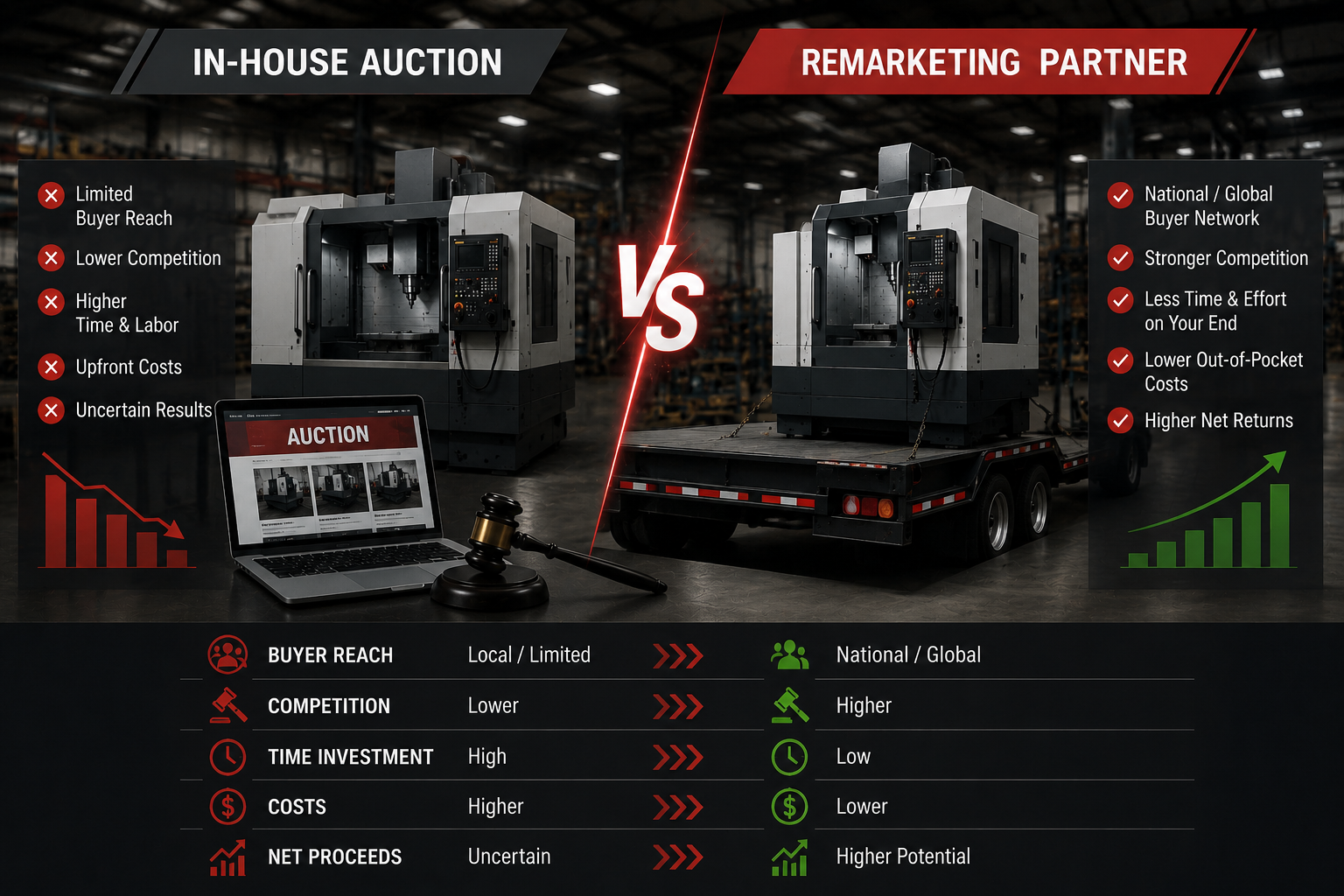
| Factor | In-House Auction | Remarketing Partner |
|---|---|---|
| Buyer reach | Local or limited to whatever list the institution has | National network of buyers who specifically deal in this equipment |
| Competition among buyers | Lower, fewer bidders driving the price | Higher, a wider pool creates real competitive tension |
| Time investment | High, staff time spent listing, fielding calls, and managing the sale | Low, the partner runs the process |
| Upfront and out-of-pocket costs | Higher, staff time plus any listing or platform costs | Typically lower, built into the disposition |
| Net proceeds | Uncertain, dependent on whoever happens to see the listing | Higher potential, driven by targeted marketing to qualified buyers |
Buyer reach is usually the deciding factor
An institution's internal list, or a generic auction platform, reaches whoever happens to be looking at that moment. A partner with an established network in machine tools specifically can put a listing in front of shop owners and buyers actively looking for exactly that equipment, which tends to matter more for net proceeds than almost any other variable.
Time investment is a real cost, even without a line item
Staff time spent managing an in-house sale, fielding buyer questions, coordinating viewings, negotiating, doesn't show up as a fee, but it's not free. That time comes from somewhere, usually from an already stretched special assets team.
Where in-house genuinely makes sense
Institutions with high repossession volume, an established internal buyer list, and staff dedicated to the process can make in-house work well. It tends to work best when the equipment is common, easy to value, and the institution already has a proven channel for that specific category.
What to Actually Weigh Before Deciding
Rather than defaulting to one approach across every disposition, it's worth weighing per situation:
- How specialized is the equipment? More specialized machines benefit more from a targeted buyer network.
- What's the volume? A single machine may not justify building in-house expertise. A steady stream might.
- What's the internal capacity right now? Staff time spent on a disposition is time not spent on other work.
- What does the documentation need to look like? A partner who produces disposition file documentation as part of the process reduces internal compliance burden either way.
Deciding Which Approach Fits
Assess the equipment type and value
Specialized, higher value machine tools generally benefit more from a targeted buyer network.
Estimate the real internal time cost
Be honest about staff hours an in-house sale would actually require, not just the absence of a fee.
Compare likely net proceeds, not just cost
Weigh expected sale price under each approach, not just whether a fee is paid.
Test with one disposition before committing either way
A single machine is a low risk way to compare real results before deciding on a standing approach.
FAQ
Doesn't paying a remarketing fee always mean less net proceeds?
Not necessarily. A wider, more competitive buyer pool can produce a higher gross sale price that more than offsets the fee, resulting in higher net proceeds than a narrower in-house sale.
Is in-house ever the better choice?
Yes, particularly for institutions with high volume, an established buyer list, and dedicated internal capacity for common, easy to value equipment.
Can the two approaches be mixed?
Some institutions do handle common, easily valued equipment in-house while using a specialized partner for higher value or more niche machine tools.
How do we know which approach nets more for our specific portfolio?
The most reliable way is a direct comparison, a valuation and disposition estimate from a specialized partner alongside a realistic estimate of in-house net proceeds and time cost.
Curious what a specialized buyer network could mean for your next disposition?
A straight comparison, no pressure, just real numbers to weigh against your current process.
Talk to a Remarketing Partner →