
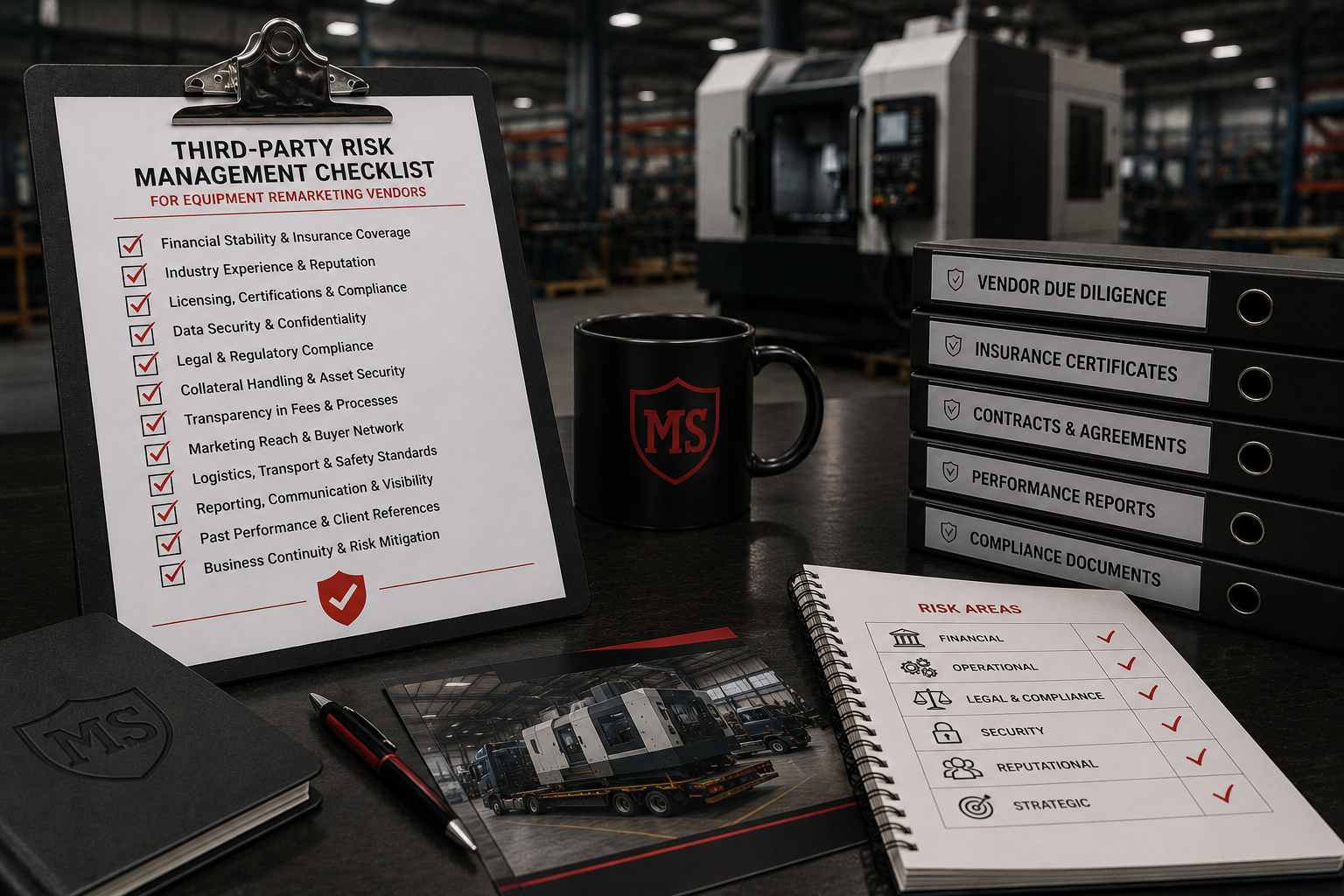
Even a strong remarketing partner, one with the right buyer network and disposition experience, still has to clear your institution's Third-Party Risk Management review before the relationship can move forward. TPRM exists to protect the institution from vendor related risk, financial, operational, legal, security, and reputational, and equipment remarketing vendors get evaluated on largely the same criteria as any other third party, with a few category specific wrinkles.
This is a general overview, not a substitute for your institution's actual TPRM policy or process. Every institution's specific requirements differ. What follows is the set of areas a TPRM review typically covers when the vendor in question handles repossessed collateral.
Why This Review Exists
A remarketing vendor is handling institution collateral, sometimes taking possession of it, marketing it publicly, and processing sale proceeds. That combination touches financial, operational, legal, and reputational risk simultaneously, which is exactly why it typically falls under formal third party risk review rather than a simple procurement decision.
Need documentation for a TPRM review?
Straightforward answers on experience, process, and references for your vendor review.
Talk to a Remarketing Partner →What a TPRM Review Typically Covers
Financial and business stability
- Financial stability and insurance coverage. Evidence the vendor is a going concern with appropriate insurance for the equipment and transactions they handle.
- Business continuity and risk mitigation. What happens to an in-progress disposition if the vendor faces a disruption.
Track record and reputation
- Industry experience and reputation. Specific experience in the equipment category, not just general vendor history.
- Past performance and client references. Other institutions or clients who can speak to actual results.
Legal and compliance
- Licensing, certifications, and compliance. Any applicable state or industry licensing relevant to equipment sales.
- Legal and regulatory compliance. General standing and awareness of the compliance context they're operating in, including UCC disposition requirements.
- Collateral handling and asset security. How the vendor takes custody of, stores, and secures equipment during the disposition process.
Data and operational security
- Data security and confidentiality. How borrower and transaction information is handled and protected.
- Transparency in fees and processes. Clear, disclosed fee structures with no hidden costs buried in the disposition.
Operational capability
- Marketing reach and buyer network. Real capability to reach qualified buyers for the specific equipment category.
- Logistics, transport, and safety standards. Competent handling of rigging, transport, and site safety for industrial equipment.
- Reporting, communication, and visibility. Regular status updates and a clear record of what's happening with the disposition at any point.
What This Actually Protects Against
A thorough TPRM review on a remarketing vendor protects the institution from a few specific failure modes:
- Collateral risk, equipment mishandled, lost, or damaged while in a vendor's custody.
- Compliance risk, a disposition that doesn't meet the commercially reasonable standard because the vendor didn't understand or follow it.
- Financial risk, proceeds mishandled or a vendor unable to complete a transaction due to its own financial instability.
- Reputational risk, a disposition process that reflects poorly on the institution if it's ever scrutinized publicly or in litigation.
Running the Review
Request documentation upfront
Insurance certificates, references, and a description of their process before the first machine is ever assigned.
Verify references directly
Speak with other institutions or clients rather than relying on the vendor's own summary of past results.
Confirm compliance awareness
Ask directly how they approach commercially reasonable disposition requirements and what documentation they provide.
Start with a limited engagement
A single machine is a reasonable way to validate the relationship before expanding to portfolio level volume.
FAQ
Does a small, specialized vendor need the same TPRM review as a large national auction house?
Generally yes, the review criteria are typically based on the risk the relationship presents, not the size of the vendor. A smaller specialized vendor may actually score better on category specific experience.
What documentation should a vendor be able to provide for a TPRM review?
Insurance certificates, references, a description of their disposition process, and information on how they handle collateral and data security are typically requested.
How often does a vendor relationship need to be re-reviewed?
This varies by institution policy, but many TPRM programs call for periodic reassessment, particularly for vendors handling ongoing or high volume relationships.
Can a vendor be approved for one equipment category but not others?
Yes, some institutions scope vendor approval to specific equipment types or transaction sizes rather than a blanket approval.
Have what you need for your TPRM review?
Direct answers on experience, insurance, process, and references, nationwide coverage.
Talk to a Remarketing Partner →