
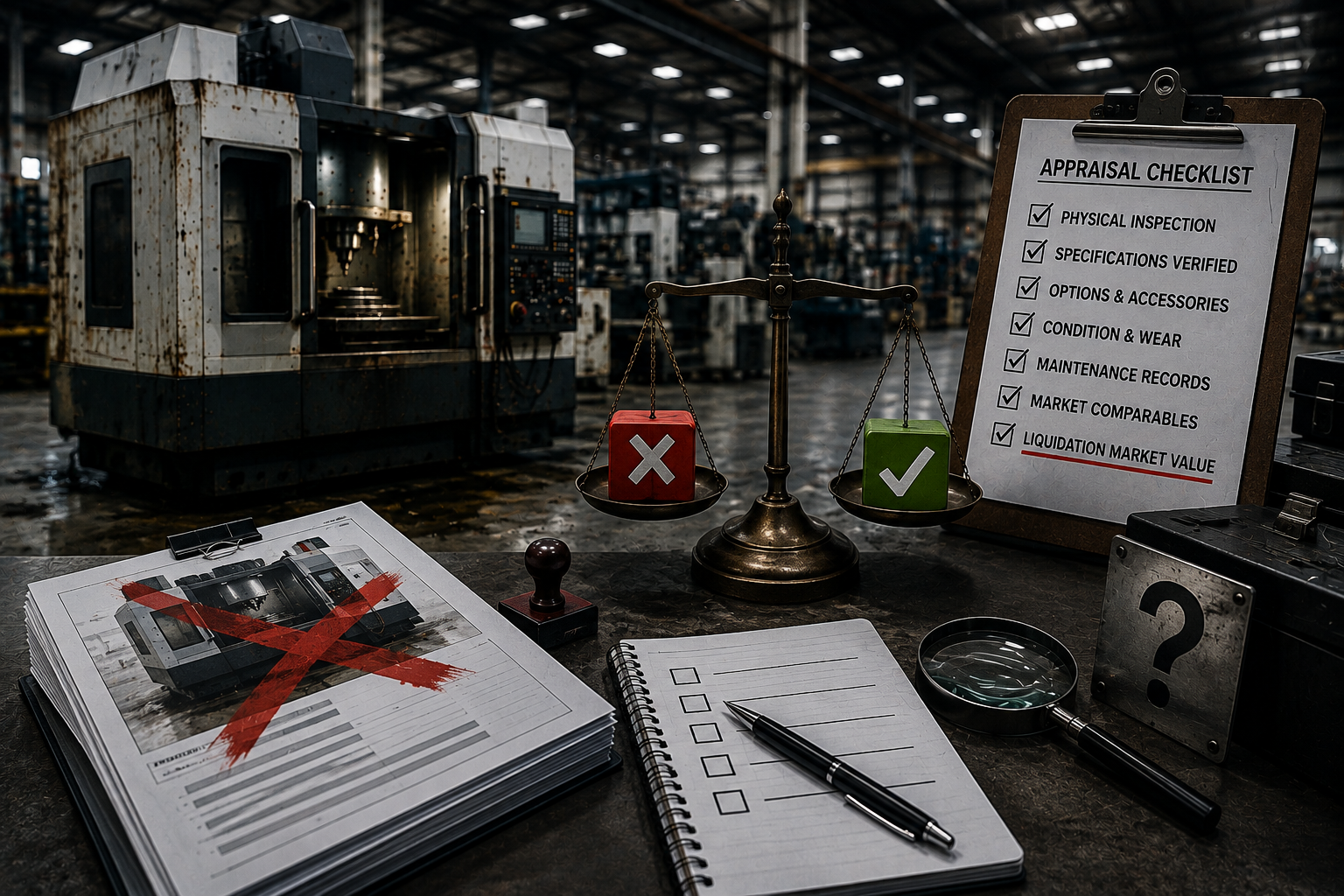
An appraisal that comes back wrong rarely fails because the appraiser did bad math. It fails because something upstream of the number was incomplete, a specification never verified, condition assumed rather than checked, a standard of value that didn't match the actual purpose of the report. Understanding where machine tool appraisals commonly go wrong is what makes it possible to ask for the right thing up front.
Why This Matters Beyond the Number Itself
As covered in our guide on desktop versus on-site valuation, a credible appraisal depends more on data quality and process than on format. That means the specific things an appraisal checks, or fails to check, matter more than whether it was done remotely or in person. A flawed appraisal doesn't just risk an inaccurate number, it can undermine deficiency calculations, disposition strategy, and the defensibility of the whole file.
Want a valuation grounded in real CNC market knowledge?
Skip the generic asset appraisal approach that doesn't understand this equipment category.
Talk to a Remarketing Partner →Where Appraisals Commonly Go Wrong
1. Specifications never independently verified
An appraisal built entirely on a borrower's or lessee's own description of the equipment, without verifying make, model, and serial number against actual documentation or the machine itself, starts from a shaky foundation. Small discrepancies in model or configuration can mean real differences in value.
2. Options, accessories, and tooling overlooked
A CNC machine's value isn't just the base unit. Included tooling, probing packages, fourth axis attachments, and other accessories can add meaningful value, and an appraisal that doesn't account for what's actually included understates the equipment.
3. Condition assumed rather than assessed
Generic assumptions about wear and condition, rather than an actual assessment or reliable documentation, can significantly misstate value in either direction, especially for equipment with unusual usage history.
4. Maintenance history not considered
A machine with thorough, documented maintenance history is a fundamentally different asset than one with an unknown service record, even if they look identical on paper. This context matters and is often missing.
5. Stale or mismatched market comparables
Comparable sales data that's outdated or drawn from a different equipment category can skew a valuation meaningfully. Machine tool markets move, and comparables need to reflect current, relevant transactions.
6. The wrong standard of value for the purpose
This is the one that causes the most confusion. Fair market value, orderly liquidation value, and forced liquidation value are different standards that produce meaningfully different numbers, and using the wrong one for the situation, as covered in our guide on ABL collateral and NOLV, can misalign expectations with what a disposition will actually produce.
What to Ask for When Engaging an Appraiser
- Confirm the standard of value up front, fair market, orderly liquidation, or forced liquidation, matched explicitly to the purpose of the report.
- Ask how specifications will be verified, not just described, whether through documentation, photographs, or physical inspection.
- Confirm tooling and accessories are itemized, not folded into a single base machine estimate.
- Ask what market comparables were used, and how recent and relevant they are to the specific equipment.
- Request the full report format, narrative summary, itemized appendix, and photographs, not just a final number.
Building a Reliable Appraisal Request
Define the purpose clearly
Lending decision, disposition planning, or file documentation, since this determines the correct standard of value.
Confirm the appraiser's credentials and category experience
CMEA or ASA designation, plus real experience with CNC and machine tool equipment specifically.
Supply complete, accurate data
Especially for a desktop engagement, thorough documentation directly determines the reliability of the result.
Review the report for the elements above
Verified specs, itemized accessories, documented condition, relevant comparables, and the correct standard of value.
FAQ
What's the difference between fair market value and liquidation value?
Fair market value assumes a willing buyer and seller with reasonable time to transact. Liquidation value, orderly or forced, assumes a sale under time pressure and is typically lower. Using the wrong standard for the purpose can produce a misleading number.
How do I know if tooling and accessories were properly accounted for?
The appraisal should itemize them separately rather than folding everything into one base machine number. If it doesn't, ask the appraiser directly what was included.
Can a valuation be wrong even if the appraiser is credentialed?
Yes, credentials matter, but incomplete data, unverified specs, or a mismatched standard of value can still produce an inaccurate result even from a qualified appraiser working from what they were given.
Should the appraiser have direct CNC or machine tool experience?
It helps significantly. A generalist appraiser without category specific experience is more likely to miss value drivers, like control vintage or included tooling, that someone familiar with the equipment would catch.
Get a valuation from someone who actually knows this equipment
Real category specific experience, not a generic asset appraisal approach.
Talk to a Remarketing Partner →