
As covered in our guide on remarketing speed and loss severity, delay costs real money, in storage, in deterioration, and in missed buyer timing. This post breaks the disposition process into its actual stages and looks at where cycle time typically gets compressed, and where it typically gets lost.
Cycle Time Is a Sum of Stages, Not One Number
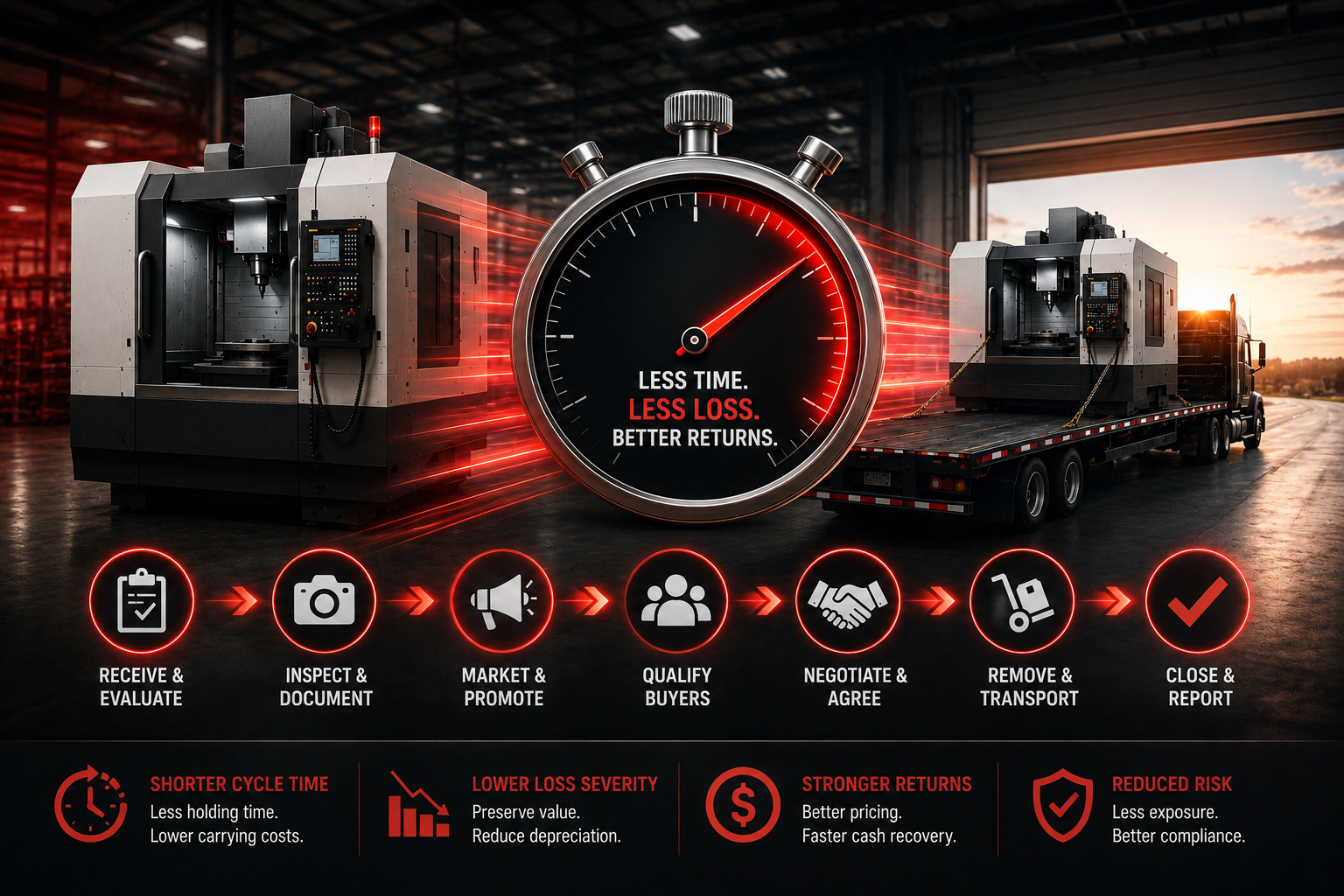
Total cycle time from repossession to closing is really the sum of several distinct stages, each with its own typical bottlenecks. Treating cycle time as one abstract number makes it hard to improve. Breaking it into stages makes clear exactly where a process is losing time, and where it's already efficient.
Want a faster disposition process end to end?
A remarketing partner built around compressing every stage of this process, not just the sale itself.
Talk to a Remarketing Partner →The Stages, and Where Time Typically Gets Lost
1. Receive and evaluate
The clock starts here. The biggest lever at this stage is how quickly the equipment gets assigned to someone who can actually move it, internal handoff delays are one of the most common and most avoidable sources of lost time in the entire process.
2. Inspect and document
A prompt, thorough condition assessment with photographs serves two purposes at once, it feeds the valuation and it becomes part of the disposition file. Doing this early, while the equipment's condition is undisputed, avoids having to reconstruct it later.
3. Market and promote
This stage benefits most from an existing buyer network. A partner who already has qualified buyers watching for this equipment type can begin real marketing almost immediately, rather than starting buyer outreach from zero.
4. Qualify buyers
Moving quickly here means having a process for verifying a buyer is serious and capable of closing, rather than losing time to buyers who aren't actually positioned to complete the purchase.
5. Negotiate and agree
Responsiveness matters most here. A qualified buyer who's ready to move can lose interest if negotiation drags out over slow back and forth.
6. Remove and transport
Rigging and transport logistics arranged in advance, rather than scrambled together after a sale agreement is reached, meaningfully compresses this stage.
7. Close and report
Settlement documentation and the final disposition file should be assembled as the sale closes, not weeks later. This is also where the file gets finalized for whatever review or audit may eventually touch it.
What Faster Cycle Time Actually Delivers
- Shorter cycle time, less holding time and lower carrying costs on the equipment.
- Lower loss severity, value preserved and depreciation reduced by moving before condition and market timing work against the sale.
- Stronger returns, better pricing from active buyers and faster cash recovery for the institution.
- Reduced risk, less exposure over time and a stronger, more contemporaneous disposition file for compliance purposes.
Where to Focus First
Close the internal handoff gap
The time between repossession and assignment to a remarketing partner is usually the single largest lever available.
Front-load documentation
Condition reports and photographs done immediately serve both the sale and the disposition file at once.
Use an existing buyer network
Marketing that starts from zero costs weeks a partner with an established network doesn't need.
Line up logistics before the sale closes
Rigging and transport arranged in advance rather than after the fact prevents a late stage bottleneck.
FAQ
What's typically the biggest source of delay?
The handoff between repossession and assignment to whoever is actually going to market the equipment. It's often the largest and most fixable gap in the whole process.
Does compressing cycle time increase the risk of a rushed, less defensible sale?
Not if the core steps, valuation, marketing, and notice, still happen, just without unnecessary delay between them. Speed comes from cutting dead time, not from skipping requirements.
How much of the cycle time is actually within the institution's control?
A meaningful amount, particularly the intake and assignment stage. Once equipment is with an experienced remarketing partner, much of the remaining time depends on buyer market conditions.
Should documentation ever be sacrificed for speed?
No. The stronger approach is doing documentation earlier and more efficiently, not skipping it. A fast sale with a thin file creates risk that outweighs the time saved.
Ready to compress your next disposition timeline?
A process built to move quickly at every stage, without cutting corners on documentation.
Talk to a Remarketing Partner →